


In the article you will learn what you can do if you have varicose veins in your legs, how to relieve swelling, what features conservative and surgical therapy has, and what preventive measures can be taken.
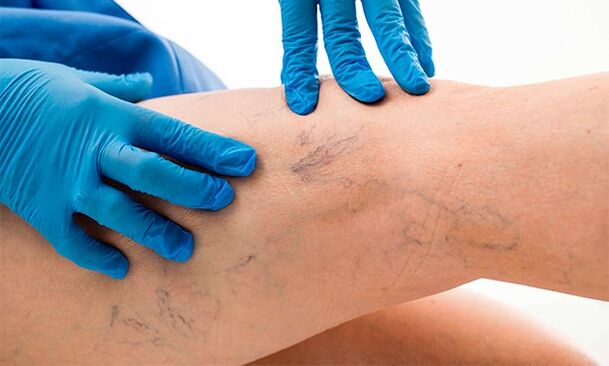
Varicose veins are a chronic venous pathology caused by malfunction of the valve apparatus, which leads to stagnation of blood flow with dilation and inflammation of blood vessels, as well as an increase in tissue stickiness.
General information
The first signs are the formation of spider veins, swelling of the saphenous veins, the formation of lumps, painful veins and a feeling of heaviness in the legs.As the disease progresses, signs of chronic venous circulatory disorder appear: swelling of the feet and legs, cramps in the calf muscles, trophic ulcers, thrombophlebitis, ruptures of varicose veins.According to various studies in the field of clinical phlebology, varicose veins affect 30 to 40% of women and 10 to 20% of men over 18 years old.
When we talk about varicose veins, we usually mean an independent disease - varicose veins of the lower extremities.Varicose veins are manifested by a feeling of heaviness in the legs and their fatigue, swelling of the feet and legs, night cramps in the legs, visual subcutaneous expansion of the veins with the formation of venous nodules.
Why do veins expand?
To understand this problem, you need to imagine how the blood, which has successfully oxygenated the body tissues, returns to the heart.In order to overcome gravity and rise from the legs to the chest, assistive mechanisms are required.First of all, we are talking about the muscles of the lower extremities, which act as a pump: their contraction when walking transports blood to the heart.In addition, valves located in the veins play an important role in this process: they prevent the blood from flowing back.
Varicose veins are a disease of the valves that no longer fulfill their function.As a result of this disorder, fluid accumulates in the vessels, which leads to their dilation.
In the future, trophic ulcers may develop in the area of deformed veins, and blood clots formed as a result of blood stasis contribute to the occurrence of a serious and fatal complication of varicose veins - pulmonary embolism.
Varicose veins of the legs are common in women and men - signs of pathology are observed in more than half of people over 18 years old.At the same time, the number of patients is growing every year - this is due to the sedentary nature of professional activity.
Varicose veins of the lower extremities are often accompanied by another well-known disease - hemorrhoids.The mode of occurrence of both diseases is the same, as are the risk factors that predispose to their development.As with varicose veins, people often ignore the symptoms of hemorrhoids until the last moment, hoping that the pathology will go away on its own.However, these diseases are irreversible without radical intervention and only progress over time.
It is believed that the main causes of varicose veins are: congenital weakness of connective tissue, hormonal changes, prolonged forced sitting or standing.Long legs and tall stature are a risk factor for varicose veins.When a person stands, the venous valves are open.The higher the blood column in the vessels, the higher the pressure.Excess weight also increases the pressure in the leg veins - fatty deposits, especially in the abdominal area, hinder blood drainage.Surges in the female hormones estrogen and progesterone during the menstrual cycle relax the vein wall.Contraceptive hormone preparations can also have an effect - it would make sense to consult a phlebologist before taking them.
Lack of physical activity accelerates the development of varicose veins in the lower extremities.However, experts emphasize the significant role of the hereditary factor: if unsightly “stars” and “worms” were observed in your parents from the vessels under the skin, then with a high probability you and your children will one day personally face this problem.The tendency to varicose veins is passed down through the female line - the sex X chromosome is assigned a gene that can lead to weakness of the vein wall.
Among other things, varicose veins occur more often in smokers, overweight people, pregnant women and people with other chronic diseases of the cardiovascular system.Professions whose representatives are predisposed to varicose veins on the legs are the following: surgeon, cashier, driver, programmer, flight attendant, loader, salesman, hairdresser, school teacher.
Pathogenesis
The veins of the lower extremities form a branched network consisting of saphenous veins and deep veins, connected to each other by perforating (communicating) veins.Blood flows through superficial veins from the subcutaneous tissue and skin, through deep veins – from other tissues.Communicating vessels serve to equalize pressure between the deep and superficial veins.Normally, blood flows through them in only one direction: from the superficial to the deep veins.
The muscular layer of the vein wall is weak and cannot force the blood to travel upwards.The flow of blood from the periphery to the center occurs due to the residual arterial pressure and the pressure of the tendons adjacent to the vessels.The most important role is played by the so-called muscle pump.During physical activity, the muscles contract and the blood is pushed upward because the downward movement is prevented by the venous valves.Maintaining normal blood circulation and constant venous pressure is influenced by venous tone.The pressure in the veins is regulated by the vasomotor center in the brain.
Valve insufficiency and weakness of the vascular wall lead to the fact that blood begins to flow not only up but also down under the influence of a muscle pump, thereby exerting excessive pressure on the walls of blood vessels, which leads to dilation of the veins, the formation of nodes and the progression of valve insufficiency.
The blood flow through the connecting veins is disturbed.The backflow of blood from deep vessels into superficial vessels leads to a further increase in pressure in the superficial veins.Nerves in the vein walls send signals to the vasomotor center, which gives the command to increase venous tone.The veins cannot cope with the increased strain;They gradually expand, elongate and become tortuous.Increased pressure leads to atrophy of the muscle fibers of the venous wall and death of the nerves involved in regulating venous tone.
Classification
There are different classifications of varicose veins.This diversity is due to the polyetiology of the disease and the diverse course variants of varicose veins.
Gradual classification
During the examination, pronounced varicose veins can be seen on the legs.Patients complain of a feeling of fullness, tingling in the lower legs and night cramps.In the evening there is slight swelling in the feet, ankles and legs.In the morning the swelling disappears.
Stage of decompensation.In addition to the listed symptoms, dermatitis and eczema are added.Patients suffer from itchy skin.The skin becomes dry, shiny and firmly connected to the subcutaneous tissue.Minor bleeding and subsequent deposition of hemosiderin cause hyperpigmentation.
Classification by shape
A distinction is made between the following forms of varicose veins:
- Segmental damage to subcutaneous and intradermal vessels without reflux.
- Segmental venous damage with pathological discharge along the superficial or communicating veins.
- Widespread venous lesions with pathological discharge via the superficial or communicating veins.
- Extensive venous lesions with pathological discharge from the deep veins.
International classification
There is a recognized international classification of varicose veins used by doctors in many countries around the world:
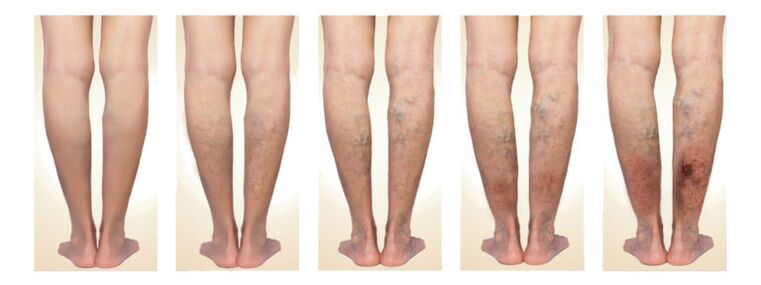
Class 0. There are no signs of varicose veins.Patients complain of heaviness in the legs.
Class 1. Vein networks and spider veins (telangiectasia) are identified visually.Some patients experience muscle cramps at night.
Class 2. When examining the patient, dilated veins are visible.
Class 3. Swelling occurs in the feet, ankles and legs that does not go away even after a short rest.
Class 4. During the examination, signs of lipodermatosclerosis are detected (dermatitis, hyperpigmentation of the legs).
Class 5. Pre-ulcers form.
Class 6. Persistent trophic ulcers develop.
Symptoms and clinical manifestations
Varicose veins affecting the veins of the lower extremities in international practice are divided into stages based on the neglect of pathology and the severity of manifestation.Each stage is diagnosed separately, all of them are characterized by different symptoms, on the basis of which the treatment method is selected.
So, the symptoms that are a sign of varicose veins at different stages:
- In the first stage, the saphenous veins of the lower extremities have a barely noticeable pattern and protrude slightly above the skin, with slight redness noticeable.At the doctor there are complaints about heaviness in the legs, swelling in the evening after a day at work.Swelling in the ankle area can occur due to shoes that are too tight, and cramps are also possible.It should be noted that painful sensations can often appear much earlier than visible signs.
- In the second stage, a typical appearance of diseased veins on the legs can already be observed: They are clearly visible above the skin and can be felt with the fingers, so that they look like knots or pearls.As it progresses, the saphenous vein of the lower extremity becomes visible and takes on a tortuous shape of dark blue or even black color.
- In the third stage, varicose veins become more complicated, signs such as trophic changes in the leg veins appear, the skin becomes dry and pale, daily swelling and cramps occur.Symptoms often include a rash on the legs and itchy, itchy skin.
- Symptoms in the fourth, most severe stage are inflammatory processes in the saphenous veins of the lower extremity, non-healing trophic ulcers, which are already difficult to treat.The main feature of this stage of the disease is the addition of secondary infection and thrombophlebitis.With these manifestations, urgent hospitalization and comprehensive use of treatment methods for the entire body are required.
Experts identify important risk factors:
- Hereditary diseases associated with varicose veins in various parts of the body;
- hormonal disorders can increase blood clotting and reduce the elasticity of the veins in the legs;
- Obesity, ascites, which increases the load on the legs, accompanied by expansion of the venous walls;
- Pregnancy or lifting heavy objects increases pressure in the abdominal cavity, which also contributes to weakening of the vascular walls and varicose veins.
- lack of load on the legs, sedentary work is fraught with expansion of the veins in the legs;
- tight underwear, smaller shoes that pinch the vein, wearing heels, which leads to stagnation of blood circulation in the leg veins;
- Varicose veins are often caused by kidney or cardiovascular disease, which results in swelling manifested by dilatation of the veins of the lower extremities.
diagnosis
The main methods for diagnosing varicose veins of the legs are:
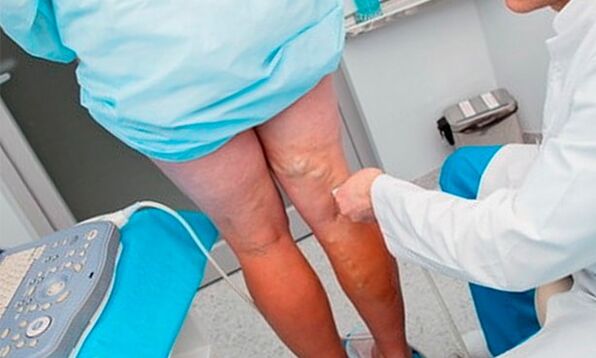
- An external examination of varicose veins on the legs should be carried out by qualified doctors in a hospital.
- Doppler ultrasound to detect wall compactions in the veins of the lower extremities.Such diagnostics makes it possible to clearly determine the stage of the disease.
- Duplex examination of the leg veins, carried out by a doctor in a specialized clinic, allows you to clearly identify varicose veins.This method, which combines ultrasound and Doppler examination, makes it possible to check what is happening to the veins: the speed of blood circulation, the diameter of the leg veins, the function of the valves and the condition that is characteristic of varicose veins.
- A phleboscintigraphic examination provides a high-precision analysis and makes it possible to detect varicose veins in the legs even at the initial stage and to take timely preventive measures.This is done by introducing a special dye subcutaneously;This fluid in the vein is highlighted in a contrasting color on the monitor.
- Occlusion plethysmography.
- With the help of tomographic disease diagnostics (MRI, computer tomography), it is possible to detect complications associated with varicose veins.
- Bandage or tourniquet tests for diagnosing diseases are used in combination as an additional method to various methods for determining the stage of varicose veins.
Deciphering the results of varicose vein diagnosis usually does not require much time.Most procedures last between 10 and 40 minutes.The treating doctor then makes a diagnosis based on the information received.Diagnostics should be entrusted only to an experienced clinician who can make a clear and accurate diagnosis, since treatment at different stages requires different methods, treatment principles and medications.
Features of treatment
There are three main methods used to treat patients with varicose veins:
Conservative therapy
Conservative therapy includes general recommendations (normalization of motor activity, reduction of static load), physical therapy, use of elastic compression products (compression stockings, elastic bandages), treatment with phlebotonics (diosmin + hesperidin, horse chestnut extract).
Conservative therapy cannot lead to complete healing and restoration of already enlarged veins.It is used as a prophylactic agent during preparation for surgery and when surgical treatment of varicose veins is not possible.
Compression sclerotherapy
In this treatment method, a special medication is injected into an enlarged vein.The doctor uses a syringe to inject elastic foam into the vein, which fills the affected vessel and causes it to spasm.A compression stocking is then placed on the patient to keep the vein in a collapsed state.After 3 days the vein walls stick together.The patient wears the stocking for 1-1.5 months until dense adhesions form.
Indications for compression sclerotherapy are varicose veins that are not complicated by the backflow of deep vessels into superficial vessels through connecting veins.With such pathological discharge, the effectiveness of compression sclerotherapy is severely limited.
Surgical treatment
The main method of treatment for varicose veins complicated by reflux through the connecting veins is surgery.Many surgical techniques are used to treat varicose veins, including microsurgical techniques, radiofrequency, and laser coagulation of the affected veins.
In the initial stages of varicose veins, photocoagulation or removal of spider veins using a laser is performed.If the varicose veins are severe, a phlebectomy – removal of altered veins – is indicated.Currently, this operation is increasingly being performed using a less invasive technique – miniphlebectomy.
prevention
After discovering varicose veins, you need to take care of cleansing the body and normalizing blood circulation.To do this, they first check the diet.The most useful for varicose veins are fresh products of plant origin:
- Vegetables - cabbage, tomatoes, peppers, greens.
- Fruits - citrus fruits, apricots, apples, peaches, cherries, cherries, apples.
- Berries - strawberries, gooseberries, currants.
- There are many traditional medicine recipes based on fresh herbal ingredients.
Unfortunately, varicose veins are a chronic disease and therefore accompany people throughout their lives.Without prevention, the disease can lead to the development of more serious complications.
- It is not recommended to take too hot baths, visit a sauna or stay in the sun for a long time in hot weather.This leads to a decrease in venous tone, which will certainly lead to congestion in the legs.
- Lead an active lifestyle, that is, move a lot.Regular exercise not only helps strengthen blood vessels, but also improves the condition of the entire body.Moderate aerobics, swimming, cycling or running are ideal for preventing varicose veins.However, weight lifting and lifting objects that are too heavy are contraindicated.
- Lose excess weight.People with a lot of body fat are more susceptible to this disease because there is more blood circulating in their bodies than people of normal weight.That's why the ships are heavily loaded.In order for the pressure on the venous vessels to decrease, overweight people must definitely get rid of extra pounds and adhere to a proper diet.As for the menu, it is advisable to limit the consumption of overly spicy foods to a minimum.It is recommended to replace animal fats with vegetable oils.
- You should not wear very tight clothing or socks or stockings with a tight elastic band, as these can put too much pressure on the veins and thereby impair blood circulation.
- When sitting, you should not cross your legs, as normal blood circulation is disrupted in such a position.
- Prolonged standing has an extremely negative effect on the condition of the veins.If you have a stable job, try to move more often.Sitting all the time is no less harmful.
- The diet should be normalized.Regular constipation and intestinal dysbiosis can lead to the development of varicose veins.You should include fiber-rich foods in your diet that help improve intestinal motility, i.e. digestion in general.
- Women should wear tight shoes and high-heeled shoes as little as possible.If you cannot do without such shoes, the heel should not be higher than 3-4 centimeters.
- After heavy standing or sitting work, you should pour cold water over your legs so that the veins always stay in shape.Baths with the addition of pine salt are also useful.You can pour cold water on your feet in the morning.
- Prevention of varicose veins involves giving up bad habits, especially smoking, which has an extremely negative effect not only on the condition of the veins, but on the human body as a whole.
- A light massage is considered an excellent preventative measure against this disease.This massage can be done independently, stroking the skin of the lower extremities from bottom to top for 10 minutes, and then in the opposite direction.This self-massage is very useful in combination with spinal massage procedures performed by a professional chiropractor or massage therapist.
- Prevention of venous dilatation also includes taking special medications that help maintain venous tone.
- Try to get rid of chronic fatigue and frequent stress.
- Doctors advise avoiding overheating and colds.
- If you have varicose veins, you should visit a phlebologist at least twice a year, who will monitor the condition of the veins and the stage of development of the disease.
To prevent illness, walk more, take a contrast shower and visit the pool.Even if you can't swim, it makes sense to just stand in the water - the water column exerts a pressure of 60-70 mmHg on your legs.Art.This is enough to pump out blood that is standing in the veins.Evening exercises have the same effect - lift your legs while lying down and do the "bicycle" exercise.
With venous insufficiency, you need to use preventive knitwear (special tight stockings and tights create a kind of frame around the veins, preventing their expansion).
By the way, such knitwear is very useful during pregnancy.Even in the first three months, when the hormones are already having a negative effect.As the fetus grows, the density of the knitted fabric needs to be increased.It is also necessary during childbirth, as this causes the blood pressure in the veins to rise sharply.